Review: Cute Bunny Holding Easter Egg Redwork
As a designer who has spent countless hours digitizing and stitching out thousands of files, I have learned that the simplest designs often carry the most weight in a commercial portfolio. When I first loaded the Cute Bunny Holding Easter Egg Redwork into my embroidery software, my initial reaction was one of relief. In an industry saturated with overly complex, dense fills that eat up thread and time, this design offers a refreshing return to clean lines and negative space. It is not just about aesthetics; it is about efficiency and wearability.
I recently had a client request a small batch of personalized tote bags for a spring boutique launch. They wanted something festive but not childish, something that would appeal to adults as much as children. This is where the redwork style shines. By stripping away heavy fill stitches, the design relies on the quality of the running stitch and the charm of the silhouette. I decided to test this specific bunny motif to see if it could hold its own in a real-world production environment.
First Impressions and Visual Personality
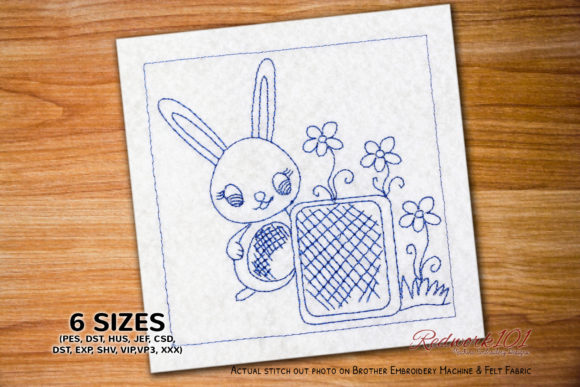
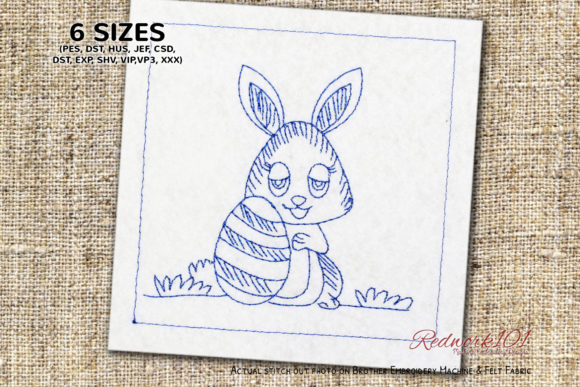
The mood created by this design is undeniably cheerful yet understated. The layout is balanced, with the bunny’s posture suggesting a gentle hold on the egg rather than a rigid pose. For embroidery designers, the appeal lies in the clarity of the shape. There are no ambiguous corners or tiny, isolated stitches that are prone to breaking or tangling. The visual personality is soft and inviting, making it an ideal candidate for products that require a touch of warmth without screaming for attention.
What stands out immediately is the versatility of the line work. Because it is primarily a redwork-style design, it translates beautifully across various fabric textures. Whether you are working with a crisp cotton canvas for a tote bag design or a soft jersey for baby embroidery, the single-line structure adapts well. It does not fight the fabric; instead, it complements the natural drape and texture of the material.
Real-World Application and Stitching Performance
In my test run, I stitched the design onto a medium-weight cotton tote bag. The performance was exemplary. Since the design avoids dense satin stitch or heavy fill stitch areas, there was minimal puckering, even without aggressive hooping techniques. This is a crucial consideration for any craft business owner looking to scale production. Less time spent fixing hoop burns or trimming jump stitches means higher throughput and better profit margins.
I also tested the design on a sweatshirt embroidery project. Here, the results were mixed but manageable. On thicker fabrics, the running stitch can sometimes get lost if the thread color does not contrast sufficiently with the garment. I found that using a slightly thicker thread, such as a 30-weight instead of the standard 40-weight, helped the design pop against the fuzzy texture of the fleece. For those creating custom apparel, this is a vital tip: always adjust your thread weight to match the fabric density.
The optional Box Stitch mentioned in the product details is an interesting feature. In most designs, the outer box is a different color, but here it appears optional. I chose to skip it for the tote bag to maintain a minimalist aesthetic, but I included it on a kitchen towel to frame the image. This flexibility allows you to customize the look based on the finished product’s requirements. If you are selling digital embroidery files, offering versions with and without the border can significantly increase the perceived value of your design assets.
Strategic Placement and Fabric Considerations
While the design is robust, it is not without its limitations. I would advise caution when placing this on highly stretchy fabrics without proper stabilization. The continuous line of the redwork can distort if the fabric shifts during stitching. Always use a cut-away stabilizer for knits to ensure the design remains crisp after washing. Additionally, be mindful of curved surfaces like caps. While the design is small enough to fit on a front panel, the lack of density means it might not stand out as boldly on structured hats compared to flat garments.
For dark fabrics, this design requires careful planning. Redwork traditionally uses red thread on white fabric, but modern interpretations allow for any color. However, if you are stitching a light-colored bunny on a navy sweatshirt, ensure your machine’s tension is perfectly calibrated. Any loose stitches will be far more visible on dark backgrounds. I recommend doing a test stitch on scrap fabric first to check thread color contrast and tension before committing to the final piece.
Commercial Value and Brand Consistency
From a business perspective, this design adds significant value to a handmade product line. It is recognizable, which aids in brand consistency if you use it as part of a seasonal collection. Customers tend to trust designs that look professional and clean. A messy, over-digitized design can signal amateurism, whereas a clean redwork piece signals confidence and skill. This subtle cue can influence buyer engagement and justify a higher price point for your Etsy listings or small shop products.
Furthermore, the simplicity of the design makes it ideal for printable mockups. When creating digital previews for your online store, the clean lines render beautifully in photos, helping potential customers visualize the final product. This is particularly important for digital product sellers who rely on high-quality images to drive sales.
Practical Designer Notes
Before you integrate this into your workflow, keep these practical tips in mind:
- Test on Scrap Fabric: Always run a test stitch to check for registration issues, especially if you decide to use the optional box stitch.
- Check Stitch Density: While low density is generally good, ensure it is not so sparse that the fabric shows through excessively on thin materials.
- Confirm Hoop Size: Verify that the design fits comfortably within your smallest hoop if you plan to do multiple items at once.
- Inspect Small Details: Zoom in on the bunny’s ears and the egg’s outline in your software to ensure there are no unnecessary micro-stitches that could cause thread breaks.
- Licensing Verification: Before selling finished items or digital products, confirm the license terms provided with the file. Ensure it covers commercial embroidery use.
In conclusion, the Cute Bunny Holding Easter Egg Redwork is a solid addition to any designer’s library. It balances charm with practicality, making it suitable for a wide range of applications from holiday embroidery gifts to everyday boutique merchandise. By understanding its strengths and limitations, you can leverage this design to create high-quality, profitable products that resonate with your customers.